
Last updated October 16, 2026
 Wrought iron
 Wood & steel frame
 Farm & ranch
 Sliding driveway gates
 LiftMaster operators
Free on-site gate assessment - hinges, posts, and your LiftMaster or Nice gate operator checked before anything is quoted
The assessment is free and the quote is the invoice.
Get your free estimateDIY vs Professional Gate Repair: The Houston Homeowner’s Decision Guide
Replacing a gate latch is genuinely a 20-minute DIY job, but replacing what looks like a gate latch when the real problem is a misaligned strike plate caused by post settlement will have you replacing that latch again in three months. That gap between what a repair appears to be and what it actually is drives most of the frustration we hear from Houston homeowners who tried the do-it-yourself route first. This guide maps common gate repairs onto a practical risk matrix so you can see which jobs have predictable outcomes for a capable homeowner, which ones hide expensive dependencies, and where the line falls between a Saturday project and a call to our Gate Repair services. By the time you finish reading, you’ll know exactly what you’re getting into before you pick up a wrench.
Quick Answer
Most Houston homeowners can safely handle gate hardware replacements like hinges, latches, and rollers when the gate posts are solid and properly aligned. But repairs involving post footings, operator wiring, frame welding, or any problem tied to Houston’s expansive clay soil carry a high risk of cascading failure, meaning a small mistake leads to a bigger repair bill within months. If your gate is dragging, sagging, or the operator is behaving erratically, the most cost-effective route is usually a professional diagnosis first, even if you do the actual fix yourself.
Styles & brands we work with
Table of Contents
- The Gate Repair Risk Matrix: What’s Safe and What’s Not
- Task-by-Task Breakdown: DIY vs Professional
- The Tool Cost Reality Check: Buying Tools vs Paying Labor
- Houston’s Clay Soil Problem: Why Post Repair Is Different Here
- Texas Electrical Code and Low-Voltage Gate Operator Wiring
- Documenting DIY Repairs Without Voiding Your Warranty
- What a Professional Repair Should Actually Include
- Common Mistakes to Avoid
- When to Call a Professional
- Frequently Asked Questions
The Gate Repair Risk Matrix: What’s Safe and What’s Not
Most gate repair advice online treats DIY as a binary question: either you’re handy or you’re not. We’ve spent years repairing gates across Houston, and that framing misses the real issue. The actual question is whether a given repair has a low failure-mode risk or a high cascading-failure risk. A low-risk repair is one where, if you get it wrong, the consequence is contained. The gate might not work perfectly, but nothing else breaks, and a professional can correct it quickly without extra cost. A high-risk repair is one where an amateur mistake creates a chain reaction: you replace one part, which shifts load to the next weakest point, which then fails, and suddenly a $40 hinge replacement has become a $900 post reset.
Here’s how common gate repairs sort into those two categories for a typical Houston residential property:
Low Failure-Mode Risk (Generally Safe for Capable DIYers)
- Gate latch and lock replacement: If the post hasn’t moved and the gate still hangs square, swapping a latch is mechanical and straightforward. The failure mode is contained: worst case, the gate won’t latch until you redo it.
- Hinge lubrication and minor hinge replacement: When the existing hinges are worn but the post and gate frame are sound, replacing hinges of the same size and bolt pattern is predictable work.
- Roller replacement on sliding gates: Worn rollers are a wear item. If the track is clean and the gate isn’t twisted, new rollers of the correct diameter restore smooth operation.
- Photo-eye sensor cleaning and realignment: Most photo-eye faults are dirt, spider webs, or misalignment from a bumped sensor. This is a cleaning and aiming job, not an electrical repair.
- Keypad battery replacement and reprogramming: Dead batteries cause a surprising percentage of “operator failure” calls we get in Houston. If the keypad still powers on, a battery swap and code reset is manageable.
High Cascading-Failure Risk (Leave to a Professional)
- Post footing repair or replacement: This is the big one in Houston, and the reason is below your feet, not in your hands. We’ll address it in detail in the soil section, but the short version: if a post is moving, everything attached to it starts wearing unevenly.
- Operator wiring and control board replacement: Low-voltage doesn’t mean low-stakes. Incorrect wiring can destroy a control board in seconds. A new LiftMaster or Viking board runs $300 to $650 for the part alone.
- Frame welding or structural repair: A cracked weld on a heavy steel gate isn’t a touch-up job. The gate’s entire weight distribution changes, and an amateur weld that fails under load can drop a gate on a car or a person.
- Actuator replacement on swing gates: The actuator, which is the motorized arm that physically pushes the gate open, has to be matched to gate weight, length, and duty cycle. Installing the wrong one burns out the motor or bends the gate.
- Spring tension adjustments on cantilever gates: Cantilever gates carry enormous tension. Releasing or adjusting that tension without the right training and tools is the gate-repair equivalent of working on a loaded garage-door spring.
The matrix above isn’t about discouraging you from working on your own gate. It’s about knowing which jobs have a predictable outcome and which ones carry a hidden multiplier on the cost of being wrong. In our experience working on Gate Repair in Houston over the years, the homeowners who save money with DIY are the ones who picked a low-risk task and executed it carefully. The ones who lose money are the ones who underestimated the dependency chain.
Task-by-Task Breakdown: DIY vs Professional
Let’s get more specific about what each common repair actually involves, so you can see where the hours and dollars really go. This is the level of detail most guides skip, and skipping it is what sends people to YouTube with false confidence instead of our Gate Repair Maintenance Checklist for Houston Homeowners.
Gate Latch Replacement: DIY-Friendly
A latch replacement on a gate that still hangs square takes two tools: a screwdriver or drill and a replacement latch that matches the existing bolt pattern. Most residential gate latches use a standard 4-inch or 6-inch bolt spread. The parts run $25 to $80 depending on whether you need a basic gravity latch, a spring-loaded latch, or a locking latch with a keyed cylinder. The honest failure mode: if the gate won’t stay latched because the post has leaned a quarter inch, a new latch will work for a few weeks, then start missing the strike plate again. That’s the post settlement problem we flagged at the top, and it’s worth checking before you spend a single dollar on parts. Stand back from the gate with the post in view. If the gap between the gate and the post is wider at the top than the bottom, the post has moved.
Hinge Replacement: DIY-Friendly With a Caveat
If your gate uses surface-mount hinges with bolted connections, replacement is a bolt-off, bolt-on job. Match the hinge size and bolt hole spacing, use galvanized or stainless hardware (essential in Houston’s humidity), and you’re done. The caveat is weight. A solid wood gate or a steel tube-frame gate can weigh 150 to 400 pounds. You cannot hold that gate in place while you swap hinges without a support. A floor jack with a block of wood, or a second person, is non-negotiable. The dangerous part isn’t the hinge, it’s the gate falling on you mid-removal. If the existing hinge has wallowed out the bolt holes in the post over years of use, simply bolting a new hinge into the same oversized holes is a temporary fix. The post needs the holes filled and redrilled, or a reinforcement plate installed. That crosses into professional territory because it changes the gate’s pivot geometry.
Roller Replacement on Sliding Gates: DIY-Friendly With Inspection
Sliding gate rollers wear out on a schedule, especially on gates that cycle many times a day. If you can see flat spots on the roller wheels or feel resistance when you slide the gate manually, the rollers are due. Replacing them means unbolting the gate from the truck assembly, swapping the rollers, and rebolting, all while keeping the gate upright. A capable homeowner with a floor jack and a socket set can do this in an afternoon. Roller sets for a typical residential sliding gate run $40 to $120 per pair depending on weight rating. What DIY rollers won’t fix: a bent track, a twisted gate frame, or wheels that wore out early because the gate was misaligned to begin with. Those underlying problems are the professional diagnosis that pays for itself.
Actuator Replacement on Swing Gates: Professional Territory
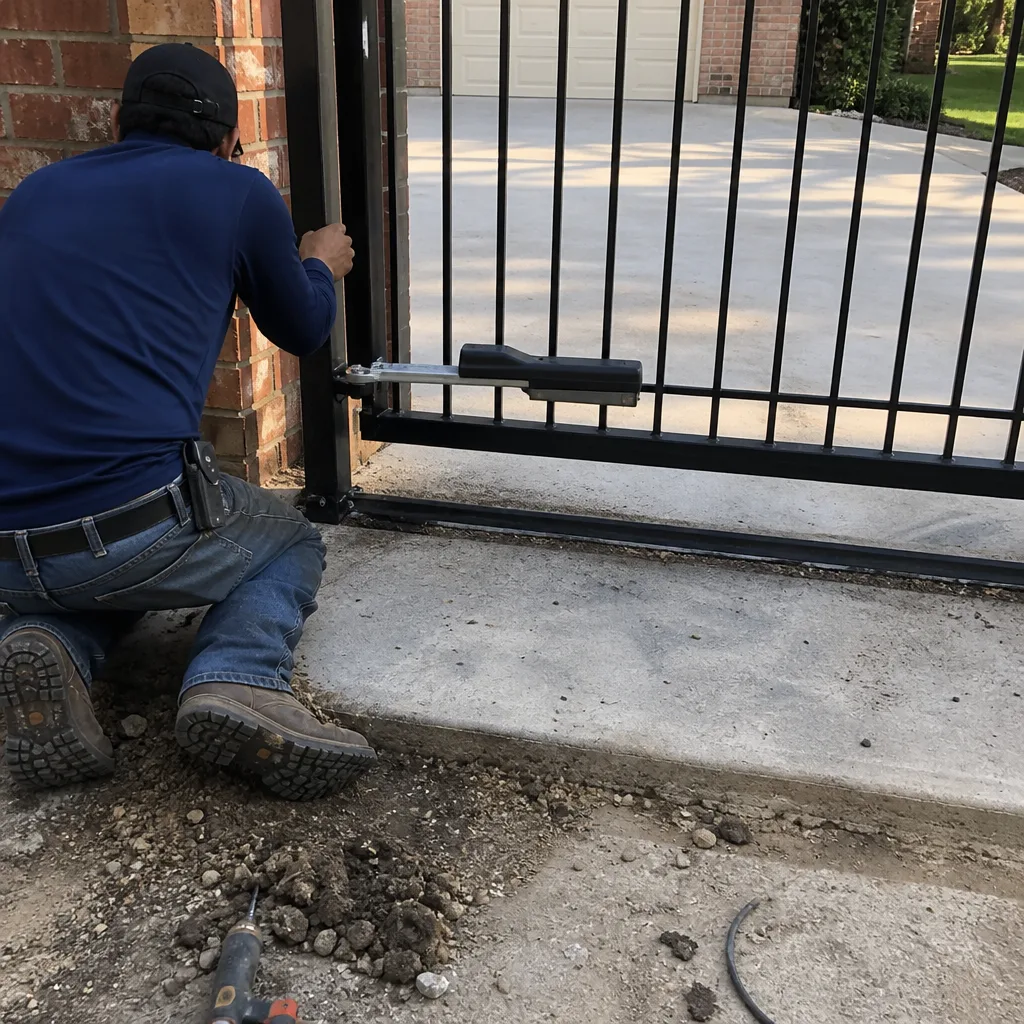
The actuator is the motorized arm that moves your swing gate. Americans call it an operator arm; the trade calls it an actuator. Whatever you call it, the actuator has to be matched to the gate’s weight, physical length, and open-close cycle frequency. Installing a too-small actuator means the motor works beyond its design capacity and fails in under a year. Installing a too-large one puts stress on the gate hinges and post. There’s also the wiring: the actuator ties into the operator control board, and an incorrect connection can fry the board. Most swing-gate actuator swaps run $750 to $1,600 parts and labor for a standard residential gate, and that range accounts for the matching, the wiring, and the testing. It’s a job worth paying for because the hidden dependencies do not reveal themselves until after the gate is cycling under load.
Post Replacement: Professional Only
Replacing a gate post in Houston means digging out the old footing, which is typically a concrete pier two to three feet deep and at least a foot wide, setting a new post plumb and square in three dimensions, and pouring new concrete that will need days to cure before the gate can hang on it. The failure mode we see most often in Houston’s DIY post jobs is a footing that’s too shallow. The homeowner digs a two-foot hole, drops in the post, pours a couple bags of Quikrete, remounts the gate the next day, and six months later the whole assembly has shifted again because Houston’s clay soil moves and a shallow footing moves with it. A proper post footing for a heavy gate in this soil needs to go below the active movement zone and often needs a wider base than a homeowner would guess. The materials are cheap; the excavation and the patience are not.
The Tool Cost Reality Check: Buying Tools vs Paying Labor
Here’s a calculation most DIY gate repair discussions avoid. If you don’t already own the tools, the cost of acquiring them can exceed the labor cost of having a professional do the job once.
Let’s price out a latch and hinge replacement, the two most commonly attempted DIY gate repairs, for a Houston homeowner starting from a basic household tool kit:
- Cordless drill or impact driver with socket set: $90 to $180 if you don’t have one, and you need the torque for gate hardware.
- Floor jack or gate support stand: $50 to $120 used, because freehanding a 200-pound gate while you unbolt hinges doesn’t work.
- Torpedo level and a good bubble level: $15 to $40 to make sure the new hardware doesn’t just look right but sits right.
- Replacement hardware (latch, hinges, bolts, washers, shims): $60 to $150 for mid-grade galvanized or stainless parts that won’t rust out in Houston’s humid climate.
- Total out-of-pocket for a first-timer: roughly $215 to $490.
A professional latch and hinge replacement on a gate that’s otherwise sound typically runs $180 to $350 parts and labor in Houston, depending on gate weight and hardware quality. If you already own the tools and consider your own time as free, DIY wins on this job. If you’re starting from scratch on tools and your weekend hours have value, the professional price is competitive, and it includes the written guarantee we’ll cover later in this guide.
The math flips hard when you get to operator-boards and actuators. A homeowner who tries to save money on an operator repair discovers that the diagnostic tools alone, a good multimeter as a starting point, plus the replacement board, plus the trip back to the hardware store for the wiring connector they didn’t know they needed, lands them within a few hundred dollars of the professional quote, without the guarantee and with the added risk of having inadvertently wired something wrong. When the repair goes south at that level, the professional has to undo your work before they can start theirs, and that diagnosis time gets added to your invoice.
Dean Prescott, the owner of Portcullis Gate Repair Houston home, puts it plainly: “About a third of the repair calls we get started as someone else’s DIY project. We don’t mind. But the customer usually ends up paying for the original parts, the labor they did themselves, and then the repair to fix the repair. The cheapest quote would have been us first.”
Houston’s Clay Soil Problem: Why Post Repair Is Different Here
If you talk to gate contractors in Phoenix or Las Vegas, post movement is a rare event. In Houston, it’s practically a seasonal occurrence, and the reason is the soil. Houston sits on a band of expansive clay that runs through much of the Gulf Coast. This clay absorbs water during wet seasons and swells, then shrinks and cracks during dry spells. A drought year followed by a wet spring moves the soil enough to shift fence lines, crack foundations, and yes, push gate posts out of plumb.
What this means for DIY gate repair is specific: any repair that depends on post stability is only as good as the footing below the post, and most existing footings in Houston were poured too shallow for the soil conditions they’re in. When a homeowner replaces a gate latch or rehangs a gate on posts that moved, they’re treating a symptom while the cause shifts underneath. The repair window is short. We’ve seen latch replacements in neighborhoods like Meyerland and the Energy Corridor that lasted three to six months before the same misalignment returned, because the clay in those areas is particularly expansive and the post kept doing what the post had been doing all along.
The reliable fix for a moving post is to excavate the old footing, pour a new one that extends below the active clay movement zone (where the soil moisture swings are less extreme), and set the post in reinforced concrete with proper drainage around it. In Houston, that often means a footing two and a half to three feet deep with a wider base than the original, and sometimes a concrete collar at ground level to shed water away from the post. It’s heavy work that calls for an auger or mini-excavator on some sites, and it’s exactly the kind of repair where the DIY cost advantage evaporates once you rent equipment and factor in the risk of getting the plumb wrong on a 300-pound post.
Texas Electrical Code and Low-Voltage Gate Operator Wiring
Most residential gate operators run on low-voltage DC power, typically 12 or 24 volts, after a transformer steps down from the 120-volt house circuit. Texas allows property owners to perform certain low-voltage work on their own property without an electrical license, and gate operator wiring generally falls into this category. That means a Houston homeowner can legally run the low-voltage wire, connect a keypad, and install photo-eye sensors on their own gate.
But “legally allowed” and “a good idea” are different things, and the line is clearer than most people think:
- The 120-volt side is not yours to touch. The transformer that plugs into or hardwires to the household circuit is line-voltage work. If the power source itself needs to be installed or moved, that’s a licensed-electrician job. The National Electrical Code applies, and here in Houston, the city follows the NEC with local amendments.
- Low-voltage wiring must be outdoor-rated and properly buried. Exposed wiring that’s not rated for direct burial and UV exposure will fail in Houston’s heat and humidity. A homeowner who runs indoor thermostat wire to a gate operator may pass a visual check for a few months and then start chasing intermittent faults.
- Control board connections are unforgiving. A control board from Linear, Viking, DoorKing, or Ghost Controls has multiple terminals for power, accessory power, outputs, and sensor inputs. One crossed wire can destroy the board. Boards are not warrantied when damaged by incorrect wiring, and the manufacturer can tell.
- Safety devices are not optional. Photo-eye sensors that stop and reverse the gate are code-mandated on modern installations. A homeowner who removes or bypasses them to “fix” a reversing gate creates a genuine safety hazard and liability. A gate that closes on a child or pet changes the calculus of what a DIY wiring job was worth.
The pragmatic approach for Houston homeowners: if the problem is a disconnected wire at the keypad, a dead battery, or a photo-eye alignment issue, go ahead and fix it. If the problem is inside the operator box, or the operator starts behaving unpredictably after a storm, that’s the time to call someone who has already worked on your exact brand. Our technicians carry boards and troubleshoot Viking, DoorKing, Ghost Controls, and Linear operators on a regular basis. Electric Gate Repair in Houston with a misbehaving operator board is not where you want to learn by trial and error.
Documenting DIY Repairs Without Voiding Your Warranty
Gate operators carry manufacturer warranties, usually one to three years on the motor and board. Gate hardware like hinges and latches is typically sold with a shorter warranty, and gate frames installed by a professional company often carry a workmanship warranty from the installer. A DIY repair can complicate or void these warranties if it’s done wrong or if it alters the original installation.
Here’s how to protect yourself if you decide to do a DIY repair:
- Photograph everything, before and after. Before you unbolt anything, take clear photos of the gate, the hardware, the operator wiring, and the post. These photos establish the pre-repair condition. If a warranty claim comes up later, you’ll have documentation that the problem predated your work or was unrelated to it.
- Tag any part you replace with the date and part number. Write the date on a piece of tape and stick it inside the operator box or on the underside of the gate frame. Future you will thank present you, and a technician who comes later can see exactly when the part changed.
- Keep the receipt for the replacement part and note the brand. If you replace a Viking part with a Viking part, the warranty picture stays clean. If you substitute an off-brand component for a manufacturer-specified one, the manufacturer warranty on related systems can get murky. The owner’s manual will say what’s specified; follow it.
- Never drill new holes without checking what’s behind the surface. A new latch with a different bolt pattern can require drilling into a hollow gate frame. Drilling into a tube steel frame in the wrong spot weakens the frame and, if the frame is under warranty, the manufacturer may decline coverage on a failure they can tie to a modification.
- Document the repair in writing, even if it’s just an email to yourself. A dated note describing the symptom, the diagnosis, the part replaced, and the result creates a paper trail that protects you and informs any future professional who works on the same gate.
These steps don’t just protect the warranty. They make a future professional repair faster and cheaper, because the technician isn’t starting from zero. We’ve arrived at gates where the homeowner had a three-year-old photo and a hand-written note explaining a previous part swap, and it saved a genuine hour of diagnosis. That homeowner got a smaller invoice because they gave us a running start.
What a Professional Repair Should Actually Include
If you do decide to call a professional, you should know what a legitimate gate repair looks like, because the Houston gate repair market has a wide range of operators, and not all of them play by the same rules.
Portcullis Gate Repair Houston has operated as a Kingswell company since 2008, which means every job, whether it’s a latch replacement or a full operator swap, follows the Kingswell Guarantee. The price is written and agreed before any work starts. The arrival window is real and the tech shows up in it. The job site is left cleaner than we found it. And every repair carries a written guarantee on the invoice. If that repair fails within 365 days, we come back and correct it at no charge under the 365-Day Done Right Promise. That’s the whole offer, in writing, on every invoice, and it’s what separates a professional repair from a guy with a truck and a guess.
The Kingswell Way, as we practice it, comes down to five plain-English commitments:
- Say the price before the work. Not a range, not an estimate to be finalized later. The price, in writing, before a single bolt turns.
- Show up in the window we gave. A real arrival window means you’re not waiting around from noon to five.
- Leave the place cleaner than we found it. No cutoff bolts, no wire clippings, no grease marks on the driveway.
- Put the guarantee in writing. A handshake is nice. A written 365-day guarantee on the invoice is better.
- Come back if it fails. If a repair fails within the guarantee period, the return visit is free.
Every Portcullis location is independently owned and operated, but each one is bound to this identical written standard. It’s not a franchise promise; it’s a written one. That matters in a Houston market where, frankly, some gate companies don’t even return the phone call when a repair fails a month later. A 365-Day Done Right Promise costs the company money every time it’s used, which is exactly why it’s the right test of whether a company believes in its own work.
Common Mistakes to Avoid
- Replacing the latch without checking the post alignment first. This is the single most common DIY mistake we see in Houston, and it’s the one that turns a $30 latch into a $700 post reset after the gate starts sagging again. Stand back and look at the gate gap before you buy any parts.
- Using indoor-grade hardware outdoors. A zinc-plated hinge from the big-box store will rust and seize within a year or two in Houston’s humidity. Use galvanized or stainless hardware made for exterior exposure.
- Skipping gate support during hinge removal. Letting a heavy gate hang by a single hinge while you remove the other can bend the remaining hinge, crack the post, or drop the gate on your feet. Support the gate with a jack or a helper.
- Burying low-voltage wire without conduit or direct-burial-rated cable. Houston’s clay soil, combined with wet-dry cycles, is rough on buried wire. The wrong cable fails intermittently, and intermittent electrical faults are the hardest and most expensive to diagnose.
- Adjusting gate operator force settings to “fix” a dragging gate. If the gate is dragging because a roller is worn or a hinge is sagging, cranking up the operator force makes the motor push harder. The gate still drags, but now the motor is burning out faster, and a burned-out operator costs more than the roller it should have gotten.
- Pouring a new post footing without accounting for clay movement. A shallow footing in Houston’s expansive clay will move with the soil, and the gate will be out of plumb again within a year. The footing has to go deeper than the active movement zone, and that typically means more excavation than a homeowner expects.
- Attempting to weld a gate frame without understanding load distribution. A cracked weld on a heavy gate doesn’t just need a filler bead. The gate has to be correctly positioned, the repair has to restore the original alignment, and the weld has to be sufficient for the full load. An amateur weld that fails later can separate while the gate is moving.
When to Call a Professional
Call a professional when the post has moved, when the operator board is involved, when the gate frame is cracked or welded, when the gate weighs more than you can safely support, or when you’ve already attempted a repair and the same symptom has come back. Those five situations cover the majority of gates we end up repairing that started as DIY projects. Portcullis Gate Repair Houston offers free estimates throughout Houston, and a diagnosis costs you a phone call. We’ll tell you honestly whether it’s a job you can finish yourself, because the $180 you spend on a professional latch and hinge replacement today is cheaper than the $900 post reset you’ll need after the next Houston clay movement cycle does its work on a misaligned repair. Call (325) 378-0676 and someone will answer.
Frequently Asked Questions
Professional gate repair in Houston typically ranges from $180 to $350 for hardware work like latch and hinge replacement, $400 to $900 for roller and track repairs on sliding gates, and $750 to $1,600 for actuator or operator-board replacement on electric gates. Post replacement, the most expensive common repair, can run $700 to $2,000 depending on gate size, soil conditions, and whether equipment access is needed. These are the real ranges we work with at Portcullis Gate Repair Houston, and the price is always written before any work starts, so the invoice never surprises you. Call (325) 378-0676 for an exact quote on your specific gate, free of charge.
Texas allows homeowners to perform low-voltage work on their own property, which includes most residential gate opener installations, but the practical answer depends on whether you’re comfortable matching an operator to your gate’s weight, length, and cycle frequency, and wiring it correctly to the control board. A Viking or DoorKing operator incorrectly wired can destroy its own board in seconds, and manufacturer warranties don’t cover wiring mistakes. Most Houston homeowners are better served by having the operator replaced professionally, with the written 365-day guarantee included.
In Houston, a gate that stops latching shortly after a DIY latch replacement almost always points to post movement from expansive clay soil. The gate and the post have shifted relative to each other, and the new latch is no longer meeting the strike plate squarely. A new latch on a moving post is a temporary fix; the reliable repair requires resetting the post with a deeper footing that reaches below the active clay movement zone.
Yes. Portcullis Gate Repair Houston offers free estimates on all gate repair and Gate Installation in Houston work. The estimate includes the exact price in writing before any work begins, so you can compare it against the cost of doing the job yourself and make the decision with real numbers in front of you. Call (325) 378-0676 to schedule yours.
Our technicians carry service training and parts access for nine major gate-operator brands including LiftMaster, FAAC, BFT, Linear, Viking, Ghost Controls, DoorKing, Elite, and Mighty Mule. That means the technician who arrives at your Houston home already knows the specific system on your property and doesn’t need to spend the first hour reading the manual.
A professional gate repair on sound posts and properly matched parts should last years; that’s why Portcullis Gate Repair Houston puts a 365-Day Done Right Promise in writing on every invoice. If the repair fails within that window, we return and correct it at no charge. If a company won’t put its own repair guarantee in writing, that’s the tell that it doesn’t expect the repair to last.
The Bottom Line
The DIY-versus-professional decision for Houston gate repair isn’t about how handy you are. It’s about whether the repair has predictable consequences when done imperfectly or hidden dependencies that turn a small mistake into a large one. Hinges, latches, and rollers on solid, square posts are honest weekend work. Posts, operators, actuators, and welds are not, especially in Houston, where clay soil movement punishes shallow footings and humidity punishes cheap hardware. When a repair has a written 365-day guarantee behind it, the professional option stops being an expense and starts being the cheaper of the two choices the moment anything goes wrong. For more guides & resources on making that call, see our blog. If you’re not sure which category your gate falls into, you don’t have to pretend certainty. You just have to call.
Written by Dean Prescott, Owner at Portcullis Gate Repair Houston, serving Houston since 2008.
See the difference
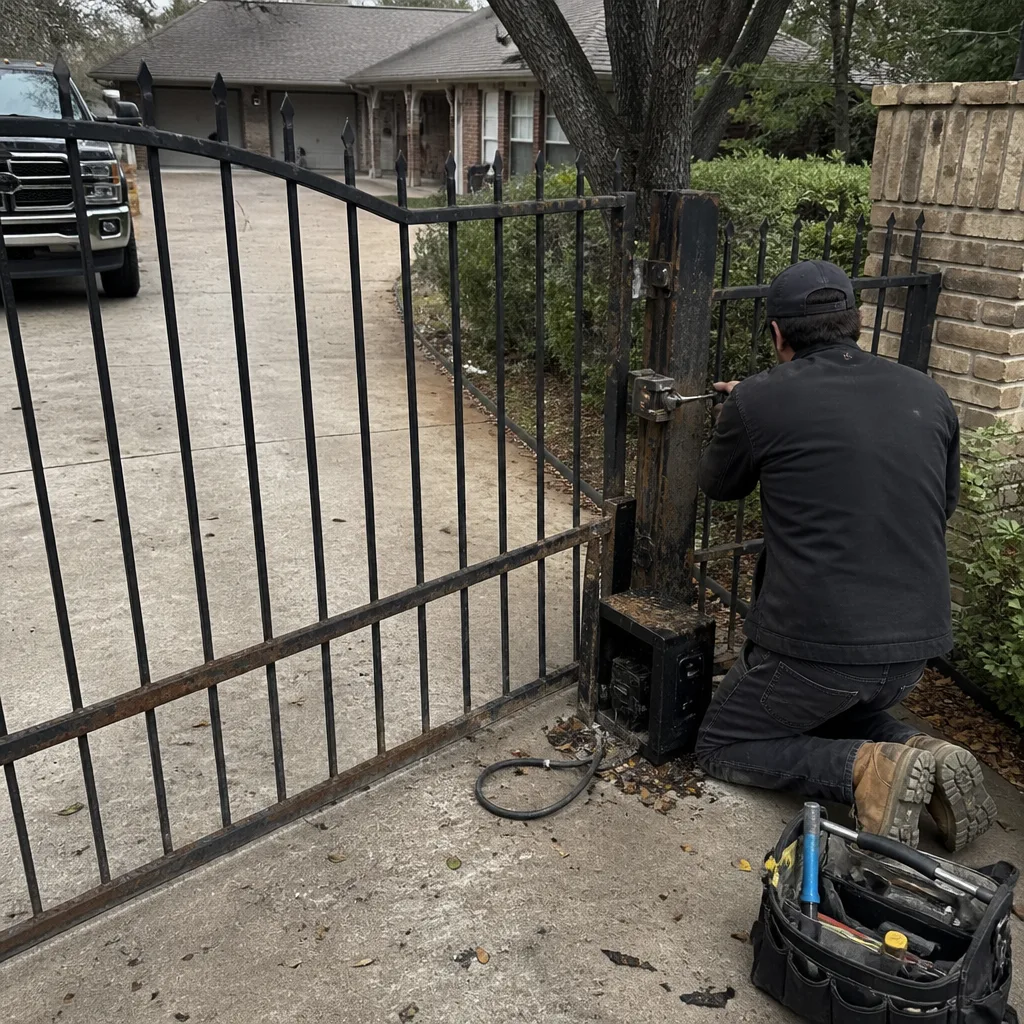 Before
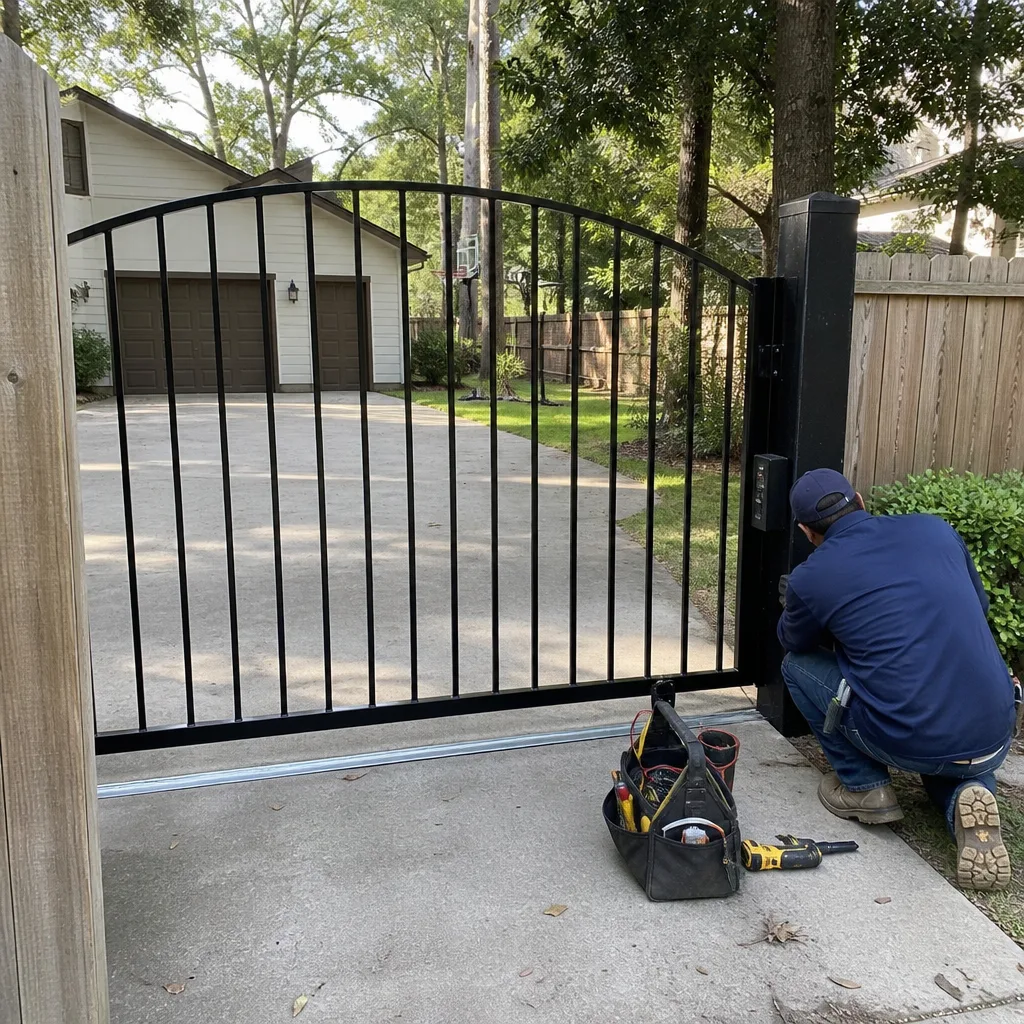 After
After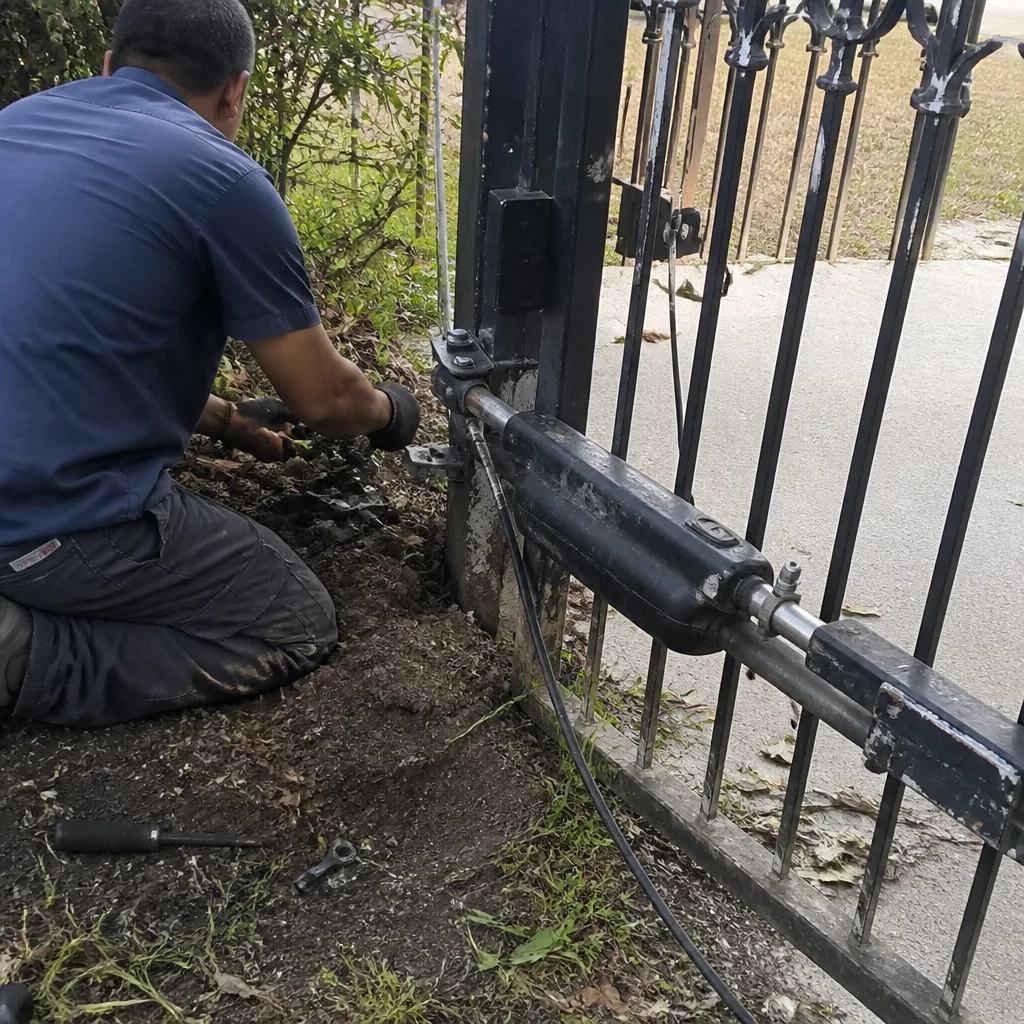 Before
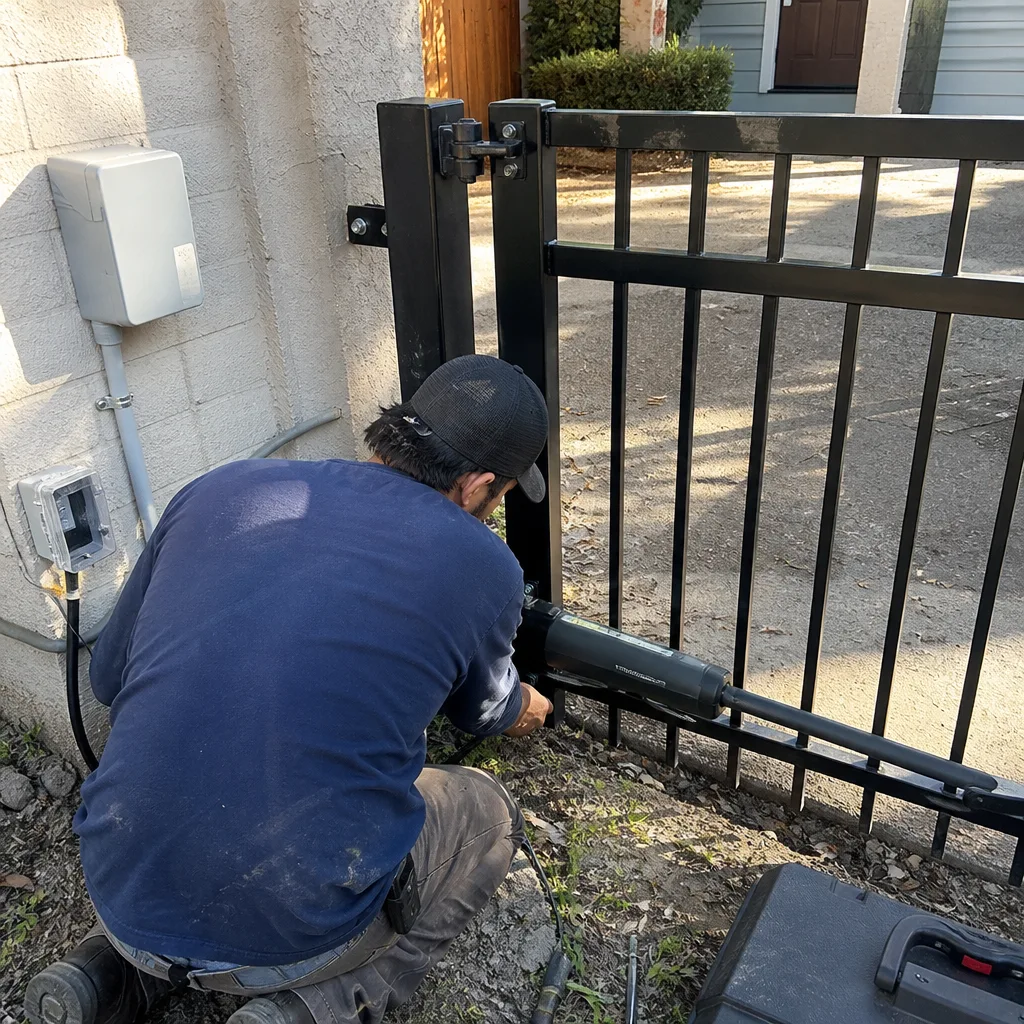 After
After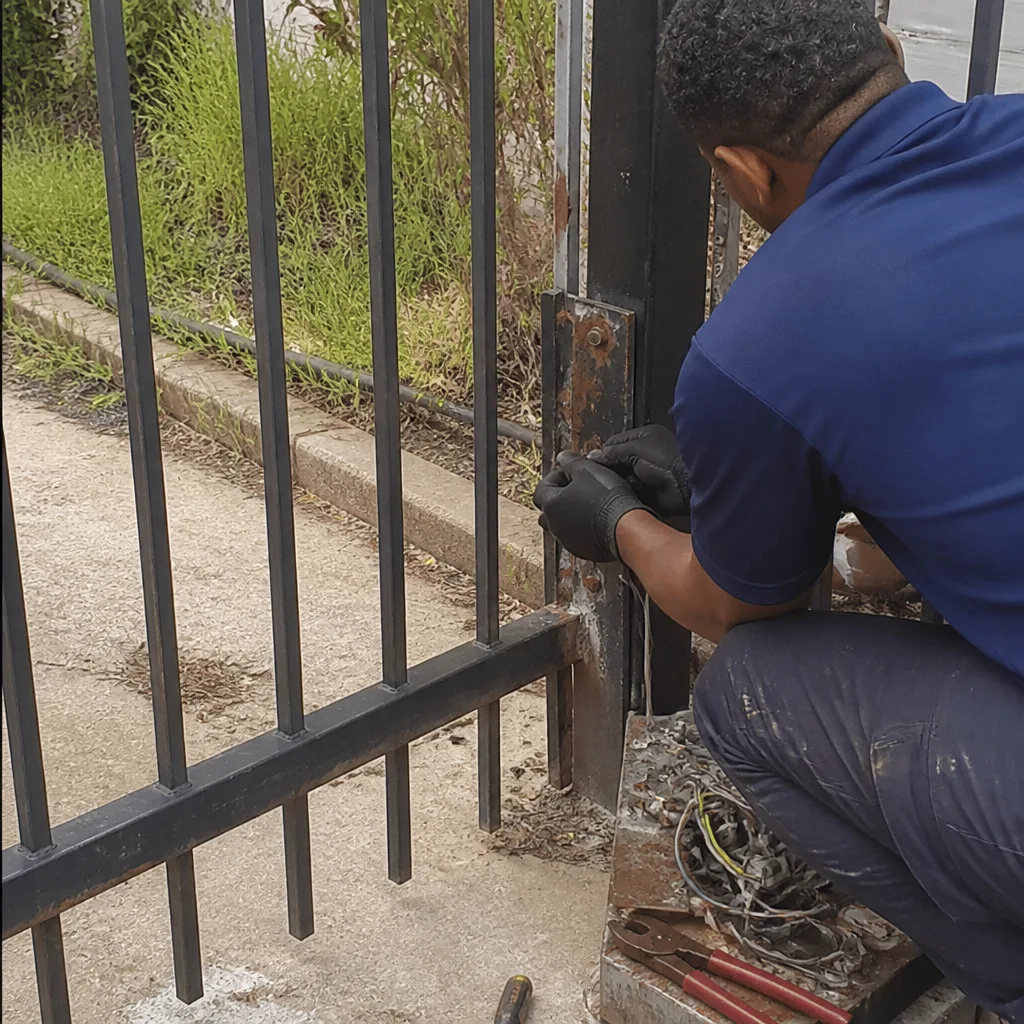 Before
 After
After